


In a nutshell:
- Digital-only banking giant Revolut has officially achieved New Zealand registered bank status—with the Reserve Bank granting its license on 3 November 2026.
- For a global challenger brand, Revolut's New Zealand savings offering feels...pretty underwhelming—unless you've got a tonne of money to invest and don't mind paying up to $79.99 per month in fees. Catches and complexity abound.
- For Kiwi savers, the best existing main bank deals are with Heartland (2.40% p.a., no fees), BNZ (2.20% p.a. with some fees) or Kiwibak (1.90% p.a., no fees)/
- Non-banks like Squirrel, Sharesies and Dosh offer no-strings attached savings rates of between 2.50% and 2.80%—and also offer protection under the Depositor Compensation Scheme of up to $100,000 per deposit.
- The verdict: judged purely on what it's bringing to the table for your average Kiwi saver, there's nothing particularly revolutionary here.

It’s official! New Zealand’s got a brand new bank.
Three years after first landing on Kiwi shores as a digital wallet provider, Revolut was granted its banking licence by the Reserve Bank on 3 November 2026.
Founded in the UK in 2015, Revolut has grown massively over the last 11 years—now with more than 70 million customers worldwide—while earning itself a reputation as one of the global banking industry’s main disruptors.
But does its new status as a New Zealand registered bank mean better things are on the horizon for Kiwi savers?
This article takes a closer look at Revolut’s personal savings account offering to see how it stacks up against the competition—and whether it delivers anything new, or is just more of the same-old same old.
Spoiler: it’s not exactly breakthrough stuff, and some main banks and many non-banks already have superior offers.
How does Revolut’s retail savings offering work?
Revolut’s savings offering is a little different from what we’re used to in New Zealand.
There are five account tiers to choose from, each carrying a different interest rate and set of benefits.
The basic ‘Standard’ plan is free—but if you want to earn a higher interest rate on your savings, you’ll need to sign up for one of their paid monthly subscriptions, with fees ranging from $5.99 per month, right the way up to $79.99 per month.
Here’s a quick summary of the interest rates and fees across the different account tiers Revolut has on offer:
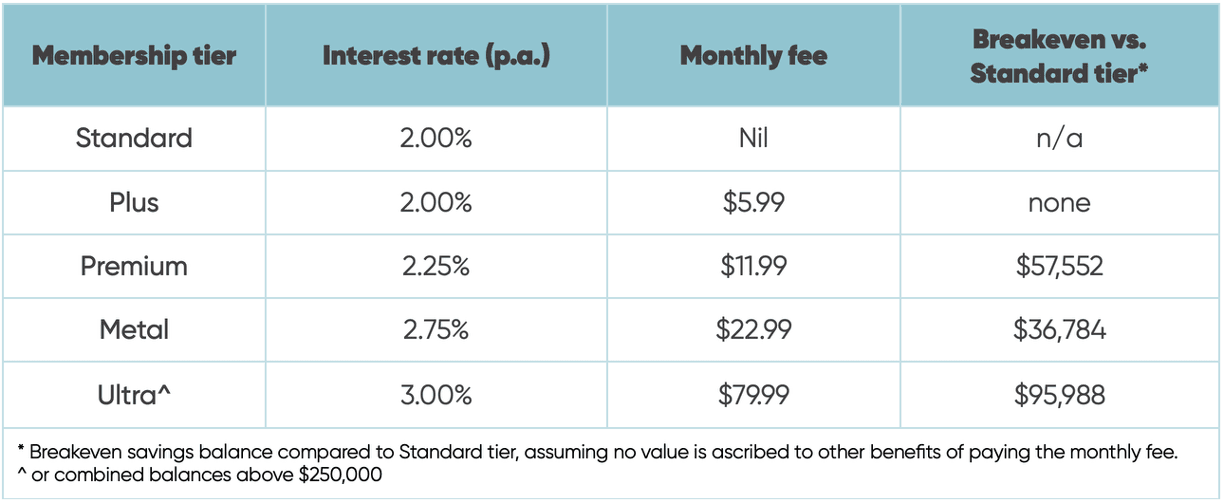
Depending on which tier you choose, benefits include complimentary travel insurance, discounted or free airport lounge access, higher fee-free currency exchange limits, and complimentary subscriptions to services like NordVPN and the Financial Times.
But if what you’re worried about is earning the best possible return on your savings, it’s that column on the right which matters most.
It shows how much you’d need to have invested for the extra interest earned on a paid plan to cover the monthly subscription fee—compared to Revolut’s free Standard offering (and assuming no value is ascribed to the other benefits on offer).
For the Ultra account, for example, you’d need almost $96,000 saved before the extra interest earned would even cover the $79.99 monthly fee.
And the picture doesn’t get any more compelling when you compare it to what’s already on offer to Kiwi savers. Plenty of existing New Zealand banks and non-bank providers have better interest rates than Revolut’s free Standard tier.
It’s worth noting that Revolut currently has an introductory offer of 3.50% p.a. on its Standard account, but there are catches. It’s only available to new customers, the rate only applies for four months, and only to balances up to $50,000.
The tiered fee system—a case of new bank, old tricks?
Up until Kiwibank arrived on the scene in 2002, monthly account and transaction fees on banking products were pretty standard in New Zealand—typically ranging from $10 to $12.50 per month, and 50c-80c per transaction.
While some banks still charge withdrawal fees on savings accounts—i.e. ANZ’s Serious Saver charges $5 if you make more than one withdrawal in a month—many everyday banking account and transaction fees have disappeared over the last couple of decades.
And it’s hard to imagine many of us are in a hurry to see them make a comeback.
For a challenger brand, bringing back monthly fees—even in a convoluted, roundabout way—feels like a bit of a step backwards.
While there are a range of other benefits on offer under the various plans, Squirrel’s view is that they’re just ‘noise’—and probably irrelevant—for most customers.
Unless you’re a frequent international traveller, it’s hard to see any meaningful upside to signing up for one of their paid membership tiers.
So, what’s the verdict?
More competition in New Zealand’s banking sector is always a good thing.
But for a brand that’s built its reputation around doing things differently, Revolut’s New Zealand savings offering feels pretty underwhelming.
Sure, its basic savings account is free—but a number of our existing banks and non-banks already offer superior interest rates on their no-strings attached savings products.
And if you’re prepared to pay for the privilege of accessing its more competitive interest rates, the numbers arguably don’t stack up unless you’ve got tens of thousands to squirrel away.
That said, Revolut’s success elsewhere suggests there’s an appetite for what it has to offer. Its all-in-one, app-based offering will no doubt appeal to a younger generation of Kiwi who value convenience, flexibility and access to a wider range of financial services.
But judged purely on what it’s bringing to the table for your average Kiwi saver, there’s nothing particularly revolutionary here.

About the author: David Cunningham, Chief Squirrel
With more than three decades of senior experience across New Zealand’s financial services sector, David knows the world of banking and finance inside out. He's not afraid to call it like he sees it (all part of our fight for a fairer financial system) which is why he's a regular media commentator on matters relating to the economy, housing market, mortgages, saving and investing, and interest rates.