


For many investors, fees are one of the first things they look at when assessing a managed fund option—and sometimes the last. A high fee can be enough to put people off entirely before they've really understood the value on offer.
It’s an idea I’d like to challenge.
Fee size matters, of course—but the idea that high fees automatically equal poor value for money is far from a universal truth.
If we’re talking about investing in index funds on the sharemarket—then by all means, fill your boots with low fee options.
This is one area where the evidence is pretty clear.
Vanguard (the firm that pioneered the ‘low fee, buy the index’ approach) currently has USD$12 trillion under management. Money’s not stupid—you don’t grow to $12 trillion without doing something right.
A quick look at the NZ-licenced funds investing in equities on InvestNow shows fees ranging from 0.03% to 2.23%. Some charge additional transaction fees when you ‘buy’ and ‘sell’ units.
That’s quite the range!
But when you start to look at managed funds investing in different sectors, the situation gets a little more nuanced.
The table below outlines key metrics across three Fixed Income / Credit funds available to invest in via InvestNow.
I chose these three specific funds because:
- One had the lowest fees;
- One has the largest funds under management in the category;
- And, of course, I thought I better see how Squirrel stacked up.
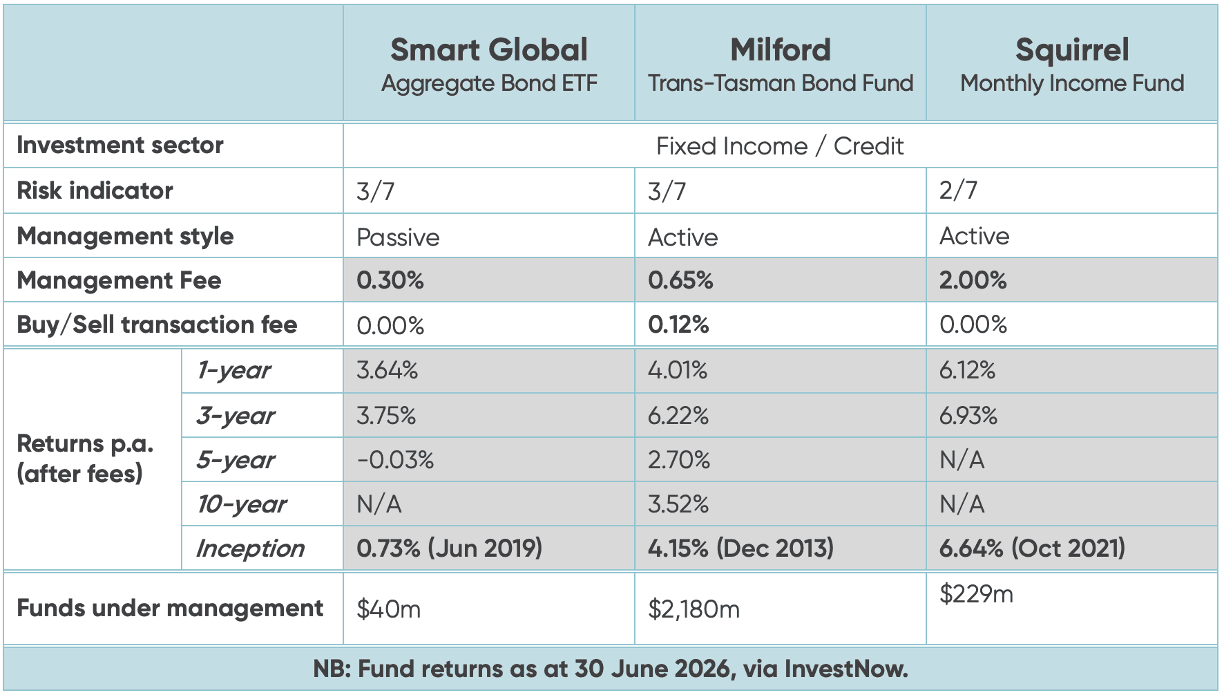
The tenure of the funds varies, but you’ll note that:
- the worst performing fund over three years has the lowest fee (perhaps not so ‘Smart’ after all?)
- the highest performing fund over three years has the highest fees and is the lowest risk of the three (not to toot my own horn or anything, but go Squirrel!).
As an aside, I’m looking forward to publishing the Squirrel Monthly Income Fund 5yr return in November. All things being equal, we’ll be looking pretty flash!
So, does the lowest-fee fund offer the best value for money? The evidence suggests not.
It's a good reminder that fees are only one part of the equation. What really matters is the return received after those fees have been paid.
The obvious question, then: why the heck is the Squirrel Monthly Income Fund fee 2.00%?
As one Reddit user recently commented: “I read [Squirrel’s] PDS and they have annual fund charges of 2%, which is INSANELY HIGH. You might not even get a positive return on your investment, but Squirrel are definitely going to get that 2% every year.
Everyone’s entitled to their opinion, but the numbers show the Squirrel Monthly Income Fund is actually a stand-out performer in its class, despite the 2.00% fee.
The size of the fee doesn’t determine the returns we generate. It simply reflects the actual cost of doing what we do, including:
- originating and managing a pool of loans secured by first mortgages over residential property, and generating a profit for ourselves while we’re at it. Most of our costs relate to people and technology.
- paying the Fund Administrator, Supervisor, Auditor, and covering the legal fees associated with running a Fund.
An additional example to put Squirrel’s managed fund fee into context
New Zealand's big banks effectively charge a higher (albeit invisible) margin than Squirrel for doing something broadly similar.
Banks take deposits and lend that money out.
On average, the gap between what they pay savers and what they charge borrowers—what’s known as the Net Interest Margin—is around 2.40% (this clearly varies across banks, but this is indicative).
While the risk profile is lower when you invest with a bank—such as in a term investment— if you consider that 2.40% bank net interest margin against Squirrel’s fee at 2.00% then I’d argue the Squirrel Monthly Income Fund offers pretty good value for money.
