


In a nutshell:
- Homeownership in New Zealand is rising after steadily falling for almost three decades. First home buyers are leading the charge, making up a record share of property purchases.
- While helped by favourable market conditions over the last couple of years, the shift looks to be more than just a blip on the radar.
- Structural changes in the market—including KiwiSaver, a better balance between housing supply and demand, and fewer investors competing for homes—all point to the change being here to stay.
- As always, there are forces which could potentially derail things, but the outlook for 2027 is favourable.
For much of the last 30 years, buying your first home in New Zealand has felt a bit like trying to run up a down escalator.
In the time it took to save an extra few thousand towards your deposit, house prices would have jumped by tens of thousands.
Open homes were packed, auction rooms even more so—and after all that hard work saving, there was a solid chance of a property investor swooping in and outbidding you.
So it’s no surprise that New Zealand homeownership was declining, fast.
After peaking at around 74% in 1991, homeownership in New Zealand fell for nearly three decades—bottoming out at 64.5% at the 2018 Census. Comments like ‘generation rent’ emerged, with predictions of fewer than 50% of Kiwis owning their own home.
Younger Kiwis copped the worst of it. Millennials are 10 to 12% less likely to own their home today than people in the same age bracket in 2001.
But the tide has turned.
The 2023 Census showed the first increase in home ownership levels in 30 years, to 66%. And by my estimates, we’re probably sitting around 67% today.
Favourable market conditions have helped, but there’s something bigger going on.
We’re seeing a number of structural changes helping to reshape New Zealand’s housing market—and there’s good reason to think it could be the start of a positive, lasting generational shift in Kiwi homeownership.
Let’s take a look.
How is the turnaround being reflected in the numbers?
It’s not new news that the last couple of years have been a Goldilocks time for anyone wanting to get a foot on the property ladder—flat house prices, lower mortgage rates and plenty of choice—and first home buyers have made the most of the opportunity.
The latest Cotality-Westpac First Home Buyer Report (October 2026) shows just how much ground they've gained.
- First home buyers are claiming record market share—making up 29.5% of purchases in the September 2026 quarter, beating the previous record (28.2%) set three months earlier—and up significantly on the long-run average of 21–22%.
- It’s happening everywhere—this year, first home buyers have made up roughly 37% of sales in Wellington and more than 30% in Hamilton and Auckland. Almost every provincial market is above its long-term average too.
- They’re getting more house for their buck—this year, 76% of first home buyers bought a standalone house, up from under 70% in 2023. And the median price they paid ($715,000) is still a touch below 2022 levels.
- Looser low-deposit rules are helping—more than half of first home buyers are now purchasing with less than 20% deposit. The Reserve Bank (RBNZ) lifted the low-deposit "speed limit" for owner-occupiers from 20% to 25% of new lending in December 2025, and first home buyers take the lion’s share of that lending.
The affordability equation has shifted significantly in buyers’ favour too.
Even after this year’s interest rate increases, a typical first home buyer is still paying considerably less per month than they would have at 2023 levels.
The table below compares minimum monthly repayments on a two-year fixed term at today’s rates vs. 2023 rates*.
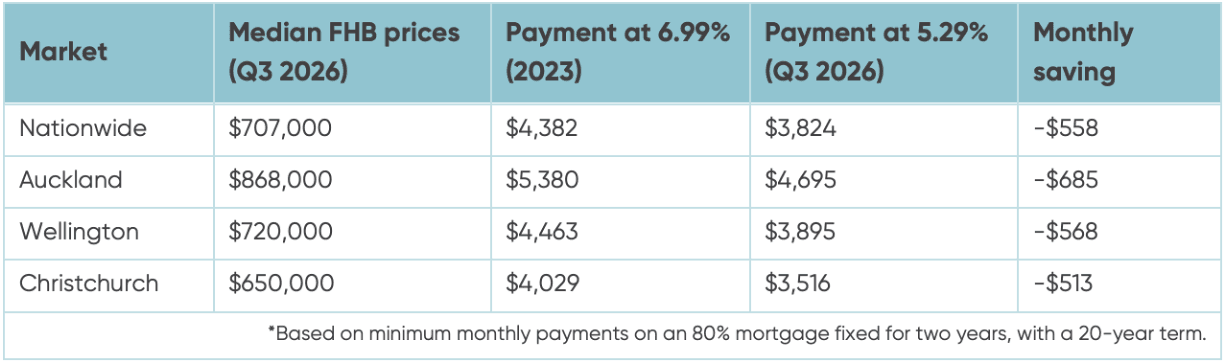
Prices are still more than 18% below their peak, and incomes have kept rising even as prices have gone sideways—meaning the numbers now stack up for a lot more people than they did five years ago.
What’s driving this shift—and why does it look like it could be here to stay?
Good market conditions come and go, but there are a number of broader, structural changes happening behind the scenes that mean this shift is likely to stick.
1. Supply and demand are finally back in balance.
What happens with house prices ultimately comes down to supply and demand, plus the cost of borrowing money.
We’ve used Stats NZ data (population growth and dwelling stock) to crunch the numbers around how many homes we’ve needed since 1991 vs. how many we’ve actually built — allowing for demolitions, empty homes and baches.
Here’s how things stack up.
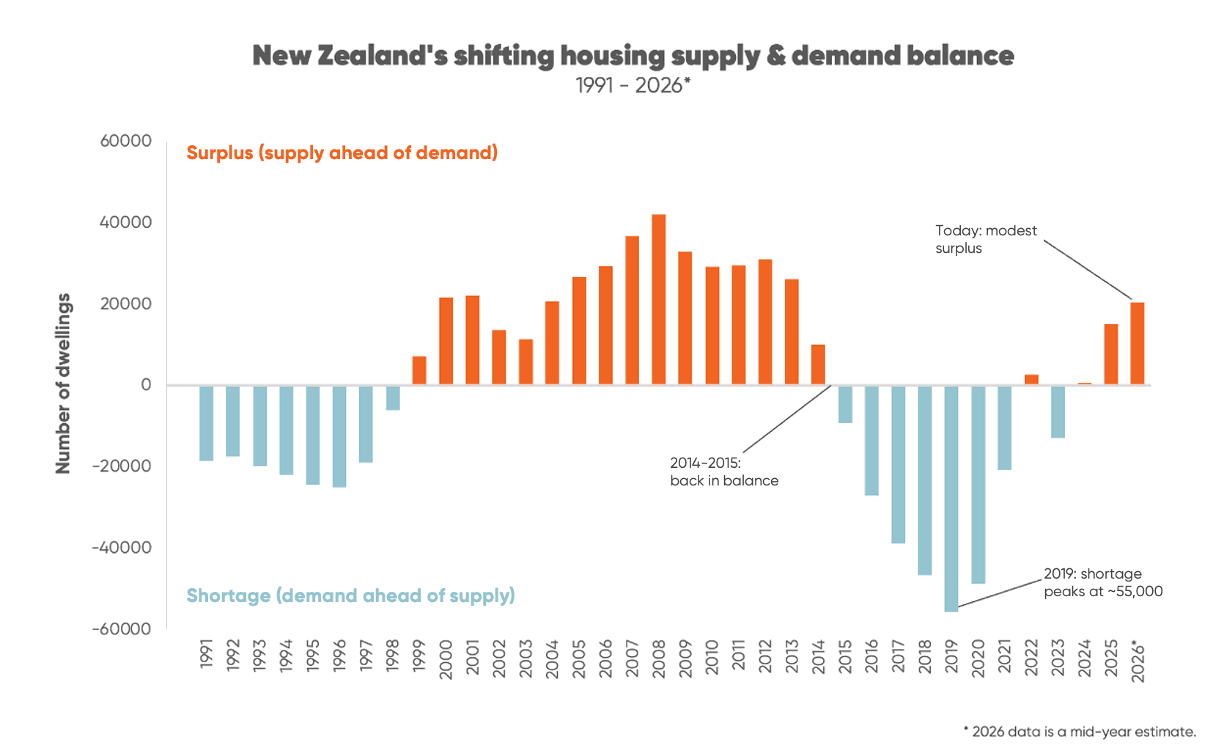
The market was roughly in balance in 2014 and 2015.
Then came a massive wave of migration (the biggest in New Zealand’s history)—and with 300,000 more people to house, residential construction just couldn’t keep up.
The number of people per dwelling, which had been drifting down for decades, started to climb—a classic sign of a housing shortage—and house prices climbed by 36% between 2014 and 2019.
By 2019, we reckon New Zealand was around 55,000 homes short.
Since then, record building and slower population growth have turned things around. By our calculations, there’s now a modest surplus of 15,000–20,000 homes.
As Kiwibank’s Jarrod Kerr put it on a recent Live at the Nut Bar episode, supply and demand are closer to balance than they’ve been in a very long time. And that’s great news for would-be homeowners.
A balanced market helps keep a lid on house prices, giving people a chance to build their deposit without having to chase a constantly moving target.
2. KiwiSaver has come of age—and is now helping to make a meaningful difference.
After almost 20 years, KiwiSaver balances are big enough to fund significant deposits.
Last year about 50,000 first home buyers withdrew around $2.2 billion from KiwiSaver towards their deposit, or roughly $44,000 each.
With an average of 1.7 KiwiSaver accounts behind each first home purchase, that’s something like $75,000 per home.
That’s a massive deposit engine previous generations never had access to.
3. Investors have stepped back.
Debt-to-income (DTI) limits, higher interest rates and tax changes have all helped to take the heat out of investor demand over the last couple of years. Pre-election uncertainty is another factor—although that could prove temporary, depending on how the results play out.
For first home buyers, it means less competition from investors with significant equity behind them.
The RBNZ’s debt-to-income rules barely come into play for first home buyers: around 94% of Squirrel’s own first home buyer clients sit under the limit.
4. The homes we’re building are changing.
Planning reforms and an ongoing shift towards medium density housing mean townhouses now make up more than 40% of new consents—creating more entry-level homes in places people actually want to live.
Anecdotal evidence from developers also suggests land is cheaper (which is one of the biggest drivers of new build prices).
5. Lending rule changes favour low-deposit borrowers—of which an overwhelming number are first home buyers.
Between looser loan-to-value (LVR) rules and increased bank appetite for lending up to 90% (in some cases 95%), the deposit hurdle is lower than it’s been in a while.
Both National and Labour have also proposed lifting Kāinga Ora’s First Home Loan income cap to $300,000—which, if it comes to fruition, will open the door to even more first home buyers.
None of this suggests that home ownership numbers will magically snap back to 1990s levels.
But for the first time in a generation, things are moving in the right direction. And, importantly, the changes helping to drive that turnaround run much deeper than a couple of years of favourable market conditions.
Are there forces that could knock this generational shift off course?
Most economists are expecting 2027 to be a relatively quiet year for house prices, with current forecasts ranging from ANZ’s -1% to Kiwibank’s 2–4%.
That’s good news for first home buyers. Modest house price recovery, plenty of choice and a more balanced market will give them time to save, plan and make decisions without feeling rushed.
Squirrel’s base case is that those conditions will hold through most of 2027.
But there are a few things which could upset the balance.
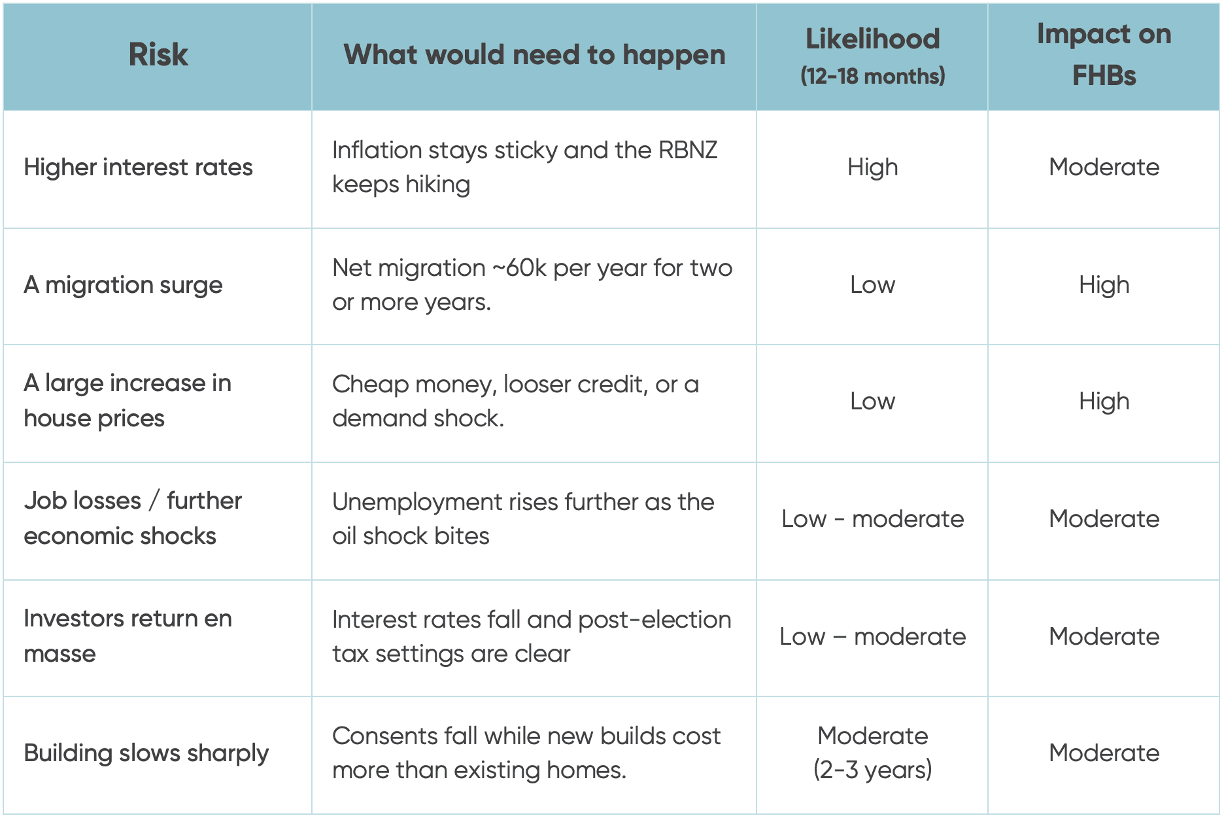
By Squirrel’s estimates, higher interest rates are the most likely spoiler.
Inflation has spiked—mostly because of oil prices—and the RBNZ has responded with two OCR hikes since July. More are likely. Even so, mortgage rates remain well below 2023’s highs, and while higher rates make borrowing more expensive, they also tend to help keep a lid on house prices.
A migration surge or a price boom both look unlikely for now. The conditions just aren’t there.
The big concern for anyone who’s bought recently with a low deposit isn’t a dip in prices, it’s job security. Losing your income while house prices are soft can leave you in a particularly vulnerable position.
Longer-term, housing supply is the issue to watch. If new builds stay more expensive than existing homes—prompting more developers to pull back—today’s surplus could become a shortage again from 2028 onwards.
The bottom line for first home buyers
For anyone look to buy their first home, it’s a pretty simple message: make the most of the breathing room you’ve got in the current market.
Take the time to do your homework, understand your borrowing options—it’s always a good idea to chat with a mortgage adviser for guidance—and don't feel pressured to rush into a decision.
For a whole generation of Kiwis, getting onto the property ladder felt like an uphill battle—but for the first time in decades, things are firmly in their favour.
Of course, conditions won’t stay this good forever. Interest rates will rise and fall, and house prices will inevitably start to track back upwards at some point.
But thanks to KiwiSaver, housing supply and demand in better balance, and fewer investors competing for homes, the foundations are there for a lasting turnaround.
And after almost 30 years of homeownership slipping backwards, that’s something worth celebrating.

About the author: David Cunningham, Chief Squirrel
With more than three decades of senior experience across New Zealand’s financial services sector, David knows the world of banking and finance inside out. He's not afraid to call it like he sees it (all part of our fight for a fairer financial system) which is why he's a regular media commentator on matters relating to the economy, housing market, mortgages, saving and investing, and interest rates.